Writing a CV
Your CV is the first, and sometimes the only document a potential employer or recruiter will see to represent you and to demonstrate your suitability for a specific role.
Recruiters look through a high volume of CV’s every day and will initially spend just six to ten seconds looking through a CV before moving on to the next. It’s vitally important, therefore, to grab and hold their attention through a CV before moving on to the next. It’s vitally important, therefore, to grab and hold their attention.
What are employers/recruiters ideally looking for in a CV?
- A solid work history i.e. longevity of employment in each position, with no unexplained gapsGaps in employment are perfectly acceptable and commonplace so don’t be concerned about them. The important thing is to put the reason for any breaks in employment on your CV, because, if you put nothing, employers will assume you were doing exactly that!
- Specific skills, knowledge, and experience that match the role(s) they’re recruiting for
- Ideally some degree of career progression from job to job
○ This isn’t always the case though and will depend on your reasons for leaving, so if you left a job for a lower grade position, it’s worth nothing the reason for this on your CV
- Relevant qualifications required for each specific vacancy (if applicable)
○ Some jobs require specific qualifications by law. Other roles may require the qualifications as desirable rather than essential criteria
○ If you are currently studying, note this on your CV too, with a note of the date you expect to qualify
- Whether you have a full UK driving licence and have a car
○ Employers need to know you can get to and from work. Some locations are not accessible bypublic transport
○ Some roles require you to have a full UK driving licence
- Your contact details
○ Your mobile phone number and your email address are required. You may have included this information on your job board profile, however recruiters will download a batch of CV’s and will be working through those, so they won’t always have your profile information to hand
- Your location
○ Your commute to work needs to be manageable on a day to day basis. Generally, employers will consider up to one hour’s travel time to and from their location as reasonable
○ Some employers perceive that candidates who are more local are more likely to stay
○ Maybe you’re relocating? If your current home location is not where you are looking to work, make sure you note this on your CV, otherwise you could be overlooked.
How does a CV search work?
- Recruiters will search on specific keywords that are contained in your CV and they will search on your home location.
They will have specific roles in mind, when they are searching, so if those keywords aren’t on your CV,
they may not find you. It’s therefore worth including each field of law or each sector of business you’ve
worked in, and note which specific case management systems, digital dictation systems, database
management systems, accounting packages etc. you’ve used in each role
What are the essentials a CV should include?
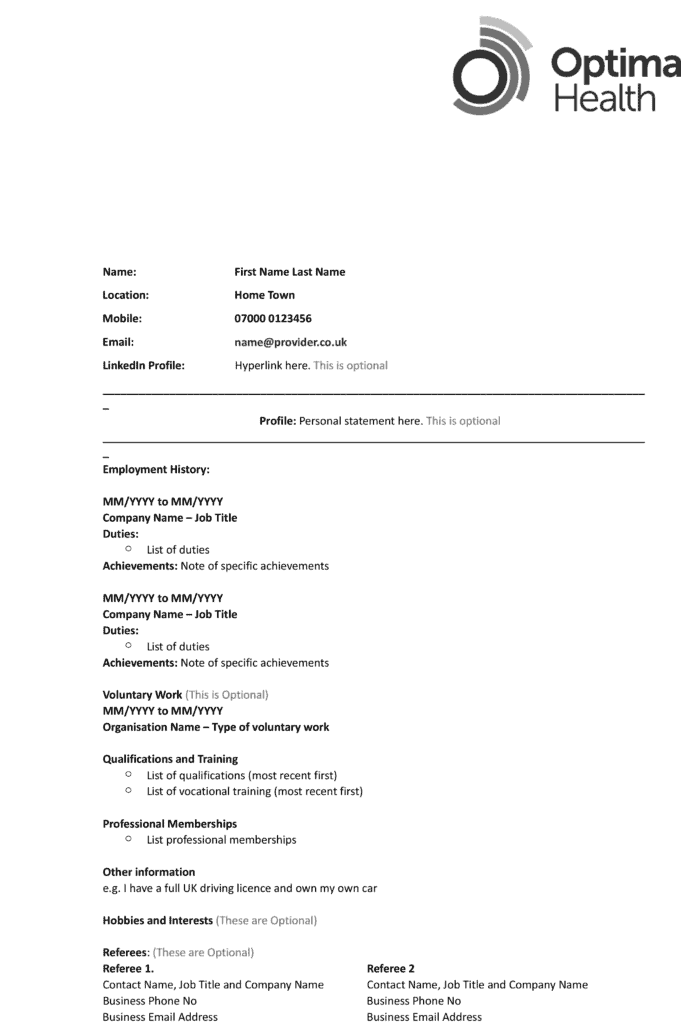
Your name, location and contact details (phone no. and email address) should always be at the top of
your CV. You don’t need to give your full address, but should note the town/city you reside in (or are
moving to if you’re relocating)
- Employment History up to 10 years
o List your last or current job first. Include dates of employment in MM/YYYY format
o Give the name of your employer, then your job title
o Next, bullet point your duties/responsibilities and be specific about your duties in each role.
Don’t be tempted to cut corners by giving vague information and/or copying and pasting the
same blurb for every role. This will just look like you couldn’t be bothered, and you could be
missing off some important keywords that will get your CV noticed.
o List specific achievements against each role e.g. targets achieved/exceeded, cost-savings
made, projects undertaken with their results noted, service levels or customer expectations
exceeded, revenue achieved, awards won, promotions achieved, ideas implemented etc.
- Qualifications, vocational training and professional memberships listed in reverse chronological order
What else could be included in a CV?
- A hyper-link to your LinkedIn profile
o Only include this if your LinkedIn profile is up to date and the dates of employment correspond
with those on your CV, otherwise it’s better to leave it off. This would be included in your
contact details section.
A profile – This is optional. If you are including a profile it should go directly underneath your contact
details, and above your employment history. It should be a short paragraph, briefly outlining your
achievements, experience and goals
- Hobbies and Interests and Voluntary Work
o Only include hobbies and interests that demonstrate you are a team-player, or that you have
leadership qualities; or hobbies that demonstrate a level of dedication and commitment
o Don’t include irrelevant hobbies and interests such as your favourite tv programmes or
socialising with friends
o Be mindful that a “love of travel” could indicate to an employer that there’s a risk of you going
off travelling for long periods
- Reference Details
o These are not essential as references aren’t usually taken out until a job offer is made.
o If you have open references or testimonials from recent employers, however, you could send a
copy of them to support your CV as validation of your work.
CV DO’S and DON’TS
- DO Keep it relevant and to the point
- DO Keep it concise. Ideally a CV should be no more than two pages long
- DO Make sure your CV is up to date
- DO Make sure your contact details are correct
- DO Make sure your CV is free of spelling errors and grammatical errors
- DON’T Copy and paste the same job description against all your previous jobs
- DON’T Leave gaps of employment with no explanation
- DON’T Use company-specific jargon or terminology
- DON’T Be too generic when listing duties of each role you’ve worked in
- DON’T Use different fonts and text sizes
See Example CV Layout.